
Open Caskets Everywhere
A turning point in the Civil Rights Movement, a turning point in Minneapolis, and the courage of ordinary Americans.

Two days ago, the New York Times published a frame by frame video analysis of Alex Pretti’s final moments. I don’t usually encourage watching these kinds of videos - we already know what happens, and I think exposing ourselves to endless streams of violence does a lot of harm.
But if you can stomach it, I think you should watch this one. You can see - and hear - the confusion and incompetence fueling these killings. You can see how individual ICE agents escalate the situation at every turn - including the one who, perhaps emboldened by the promise of “absolute immunity” from the White House, hits a defenseless Pretti in the face with a can of pepper spray, then later fires several rounds at his motionless body.
If your accountant or plumber acted with this level of professional incompetence, you would sue them. But when it comes to armed agents of the state killing American citizens in the street, it seems likely they’ll never face any sort of discipline, much less prison time.
But what really struck me as I watched the analysis of Pretti’s killing — with multiple camera angles and audio sources — was this: imagine if there had been no video at all.
When ICE claimed Pretti was trying to “massacre law enforcement,” there would have been no way to contradict them. With only the government’s side of the story, we probably would have moved on - and ICE agents would have felt even less hesitation about shooting the next protestor.
The whole thing reminds me of a story I learned in high school history class.
There’s a good chance you’ve heard it to. In 1955, Emmett Till, a Black teenager from Chicago visiting relatives in Mississippi, allegedly whistled at a white woman, Carolyn Bryant, in a general store. A few days later, Bryant’s husband and brother-in-law abducted, tortured, and murdered Till before dumping his body in the Tallahatchie River.
Today, “the officer feared for his life” has become the catch-all excuse for ICE agents who kill people. Back then, Carolyn Bryan testified at her husband’s murder trial that she was “just scared to death” of 14 year-old Till. The defendents were acquitted by an all-white jury in less than an hour.
None of this, tragically, was particularly out of the ordinary in the Jim Crow South. What turned Till’s lynching into a watershed moment was a decision by his mother, Mamie, a week after her son’s death. When Mississippi officials tried to bury Emmet Till’s body quickly, Mamie insisted on having it brought back to Chicago. When a funeral director offered to “touch up” the body before the memorial service, Mamie turned him down. Instead, she held an open casket funeral, so that people could see with their own eyes what had happened to her son.
People did. 50,000 Chicagoans viewed Till’s body. You can see some old newsreel footage of mourners reacting to that sight - it’s powerful and deeply disturbing. Jet magazine published photographs of the body. The brutality of Jim Crow was put on undeniable display in a way it had never been before. Many historians credit Till’s funeral with helping to galvanize acts of public resistance that soon followed, like the Montgomery Bus Boycott later that year.
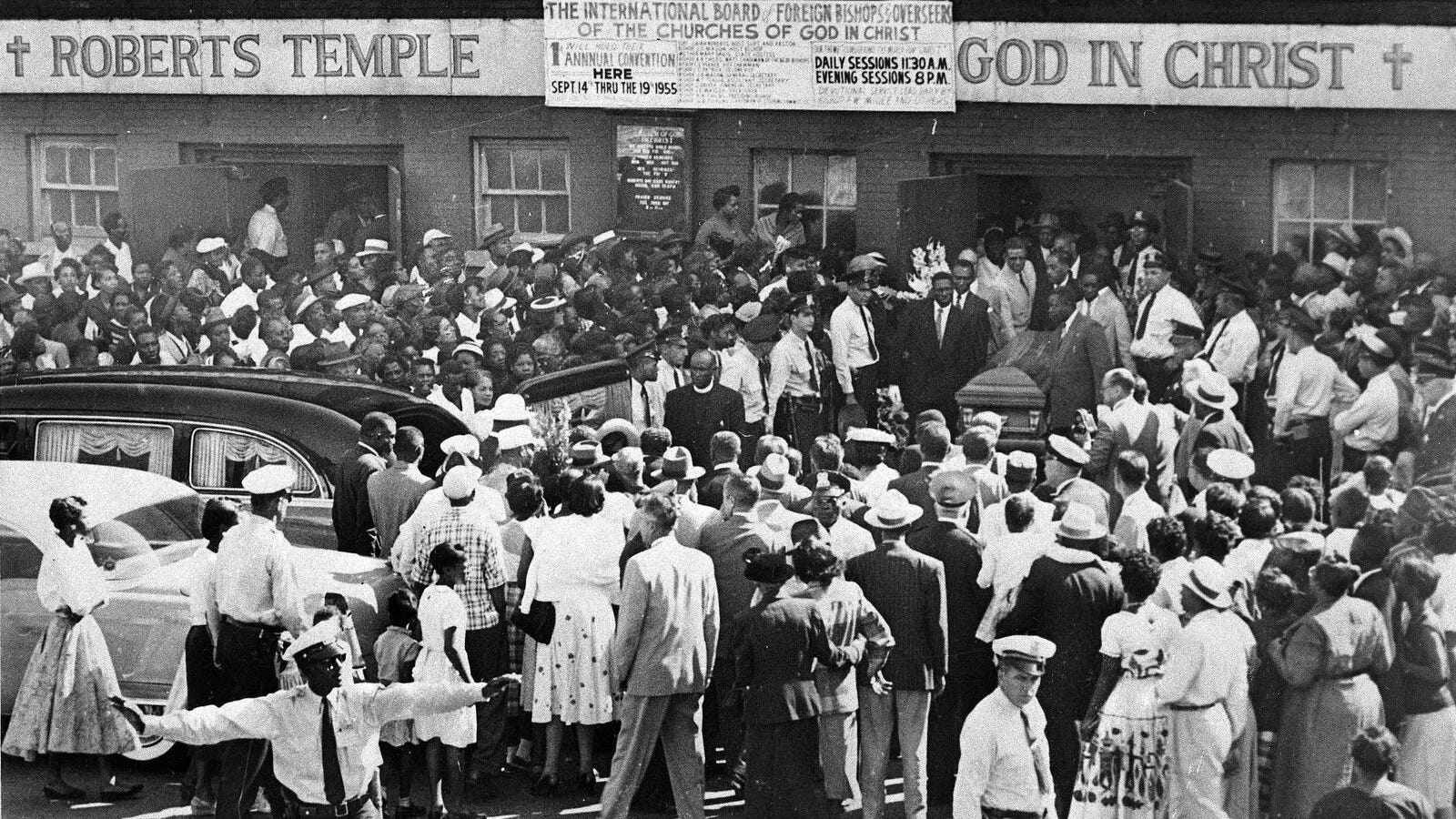
This is the kind of story the Trump Administration would probably like to ban from our classrooms. They’d say that teaching kids the history of Emmett Till’s murder puts America in a bad light.
I don’t think that’s true, though. Obviously, the thugs who murdered Till represent America at its worst. But just think about the courage Emmet Till’s mother summoned - the foresight she displayed, the added agony she was willing to endure so that the world could see what happened to her son. And the strange sort of hope embedded in her choice, the confidence that if only we could see what was actually happening in our country, to our fellow Americans, things might begin to change.
She must have known, too, that her decision would turn her into a public figure and invite criticism - that she’d be accused of “stirring up trouble.” She wasn’t an influential leader or an activist. At the time of her son’s murder, she worked as a clerk handling files for the Air Force. But she changed American history nonetheless.
That’s who I’ve found myself thinking of as I’ve watched the videos pouring out of Minneapolis: of Pretti’s killing, of Renee Good’s, of American citizens beaten and wrongfully detained, of law-abiding immigrants - in some cases, children - torn apart from their families and subjected to disgusting and inhumane treatment.
They haven’t always been able to prevent tragedies. But they’ve helped to ensure that those tragedies mattered, that lives lost weren’t lost in vain. They’ve created a parade of open caskets, exposing the lies told by the country’s most powerful and allowing the rest of us to see for ourselves what happens what Trump and MAGA hope to do not just to Minneapolis, but to any community that refuses to submit to their demands.
It’s too soon to know where we’ll end up. But it’s already clear where we’d be without these heroes behind the camera, risking their safety and even their lives to bear witness. Their courage - their insistence that our Constitution protects all of us, their understanding that the rights we’re guaranteed mean nothing without people to make them real - is what America at its best still looks like. Like Till’s mother, they have faith that the sacrifices they’re making will not be in vain, that once Americans see such grave injustice they will, however slowly and haltingly, start to correct it.
Thanks, David. I've been thinking about Emmett Till and his mother, too, this week. Sometimes pictures are worth 10,000 words. My camera is now within reach of my hand every time I go out my front door.
Thanks, David, from Minneapolis for a powerful reminder. In WaPo today George Will (George Will!) compares my hometown to Birmingham when photos recorded the vile tactics of Bull Connor, causing national revulsion and outrage. David Litt and George Will reading from the same hymnal: in a way, it's a footnote to "It's Only Drowning."