
Blowing Stuff Up is Not Winning
Trump's Losing in Iran for the Same Reasons He Lost in Minneapolis

First off: a huge thank you to everyone who switched to a paid subscription over the weekend.
Thanks to all of you, Word Salad made Substack’s “rising” list for U.S. Politics - by far the most competitive category - which helped more people discover the newsletter. And I know some of you tried to sign up but couldn’t because of an issue with our payment processor.
That issue’s been fixed, so I’m re-upping the link below. For everyone subscribing, thank you again!
(I also got some great ideas from readers about features I can hopefully add over time. I’ll be rolling those out as soon as I can. And if you’ve got more suggestions, I’d love to hear them.)
I spent all morning battling spreadsheets, trying to fully crunch the numbers on a red states vs. blue states policy deep dive. But I’d rather take the time to get it right, so I’m going to hold off posting that one for a little bit. Instead, I wanted to write a quick note on an idea that I think applies to almost everything happening during Trump 2.0.
Harmful is not the same thing as effective.
We’re seeing that most glaringly, and maybe most catastrophically, in the Middle East. Trump now says we’ve achieved regime change because we took out Ayatollah Khamenei. And replaced him with… Ayatollah Khamenei.
Pete Hegseth, meanwhile, gives his daily briefing about military capacity, how many targets we’ve hit, how American firepower is growing and Iran’s is decreasing. All these things are true. If war were a game where you scored points for blowing up the most stuff, or killing the most people, we’d win easily.
Some people seem to think that’s what this war is. Bret Stephens, in a New York Times Piece titled, “The War is Going Better Than You Think,” made what I thought was a genuinely well-argued case that we’re winning. But that’s the thing about good arguments: when they’re weak, it’s revealing. Stephens pointed out, correctly, that if you look at U.S. losses vs. Iranian losses, we’re doing better than in any recent war - not just Vietnam or Afghanistan, but also military adventures like the 1989 invasion of Panama.
Of course, by that logic, World War II was a disaster.
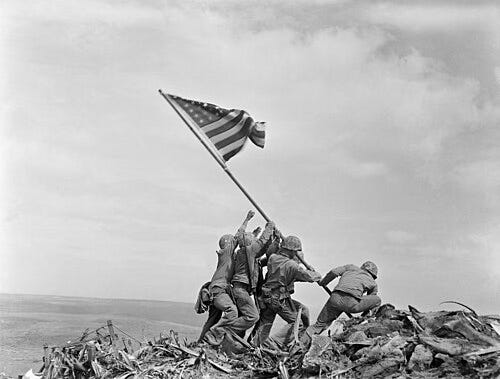
Most Americans don’t see it that way. Instead, we are, for all our faults, more rational than many of our leaders: we ask ourselves not just, “Are we winning,” but “Is this worth it?” And when it’s completely unclear what benefit we hope to gain (or even worse, when our objectives are something like, “We can end this war by re-opening the Strait of Hormuz which is only closed because we started this war”) it’s very hard to conclude that it’s worth the cost - even if we’re losing fewer American lives per enemy killed than we have in previous conflicts.
I’m not the first person to point this out. And I promised a quick note. But what I want to do quickly is connect this to a broader Trump 2.0 mistake.
The president and his advisors keep confusing doing damage with winning.
And it’s a big reason they’re losing.
In Minneapolis, ICE brutalized protestors and in some cases killed them. Ultimately, Trump had to backtrack, because Americans hated what they saw.
During the DHS shutdown, Trump has seemed eager to cause as much pain as possible - sending ICE agents into airports, refusing to support a bill to fund TSA, etc. Americans aren’t blaming Democrats, though. They’re fed up with Trump.
DOGE shuttered federal agencies and cut off USAID assistance for millions of people. It will be a long time if we know how many people died as a result. But ultimately Elon Musk was sent packing, and while lots of public servants were fired, government didn’t actually shrink.
This is a big departure from Trump 1.0. Back then, I thought John Mulaney’s joke about how Trump is like a horse loose in a hospital was the perfect way to summarize Trumpism. What I didn’t think about, but what was actually an important part of that joke, was that the horse doesn’t actually do anything. He clomps around. He gets a ton of attention. But the patients’ lives are all essentially unchanged. (There’s a reason that joke came from a special in 2018, rather than after Covid.)
In Trump 2.0, I think the best farmyard-animal analogy is unfortunately less clever: Trump is a run-of-the-mill-bull in a China shop. He doesn’t just freak people out. He breaks a lot of stuff. Some of that stuff is irreplaceable. If you care about the stuff that’s being broken, the harm isn’t theoretical, it’s very real.
But also: the bull doesn’t end up owning the store.
With the Iran War, a GOP mantra has become “short-term pain for long-term gain.” Actually, time and again, it’s been the opposite. The short-term pain is materializing. The long-term gain - for MAGA politically, or America more generally - is not.1
Of course, in Trumpworld, the number one rule is to never admit you were wrong. So you’re never going to hear Trump or his advisors say out loud that their strategy isn’t working. Instead, they’re going to retroactively decide that inflicting pain was the goal all along.
But Democrats don’t have to fall for that bluster. Americans certainly aren’t falling for it. For all his talk about strength and toughness, Trump and his team still don’t understand how power works. And until they figure it out, they’re going to keep flailing.
Got your own farmyard animal analogy. Let me know in the comments! (Keep it relatively clean, please, there are children reading.)
You could argue, I guess, that if the real goal of MAGA is to enrich Trump’s allies, Trump 2.0 is going really well. And if I were a Democrat running in 2026 or 2028, that’s probably exactly what I would argue.
“You can’t make a silk purse out of a Pig’s ear.” This is in reference to tRump building memorials to himself such as his “dining room” which is really a military data center, his columns and arches and his name on gold and all paper currency.
When Trump rattles on at his rallies, he appears as happy as a pig in mud. But behind the scenes late at night, he tweets just the opposite. He and his idiotic team count their chickens before they hatch: blithering on about bombing Iran "just for fun", counting their successes--then moving on to what is more important--Corinthian columns. Meanwhile, Iran takes note of what the U.S. blows up, how many Iranians dead, lining up their soldiers, and waiting.....